Thank you Bill
Lower Value
Human Capital
On Tuesday May 20, 2026, Standard Chartered CEO Bill Winters described a planned reduction in support staff as "replacing in some cases lower-value human capital with the financial capital and the investment we're putting in.This pop-up page is a small musical thank-you note to Bill and anyone else helpfully clarifying the exact market price of a human soul.
An open letter ...
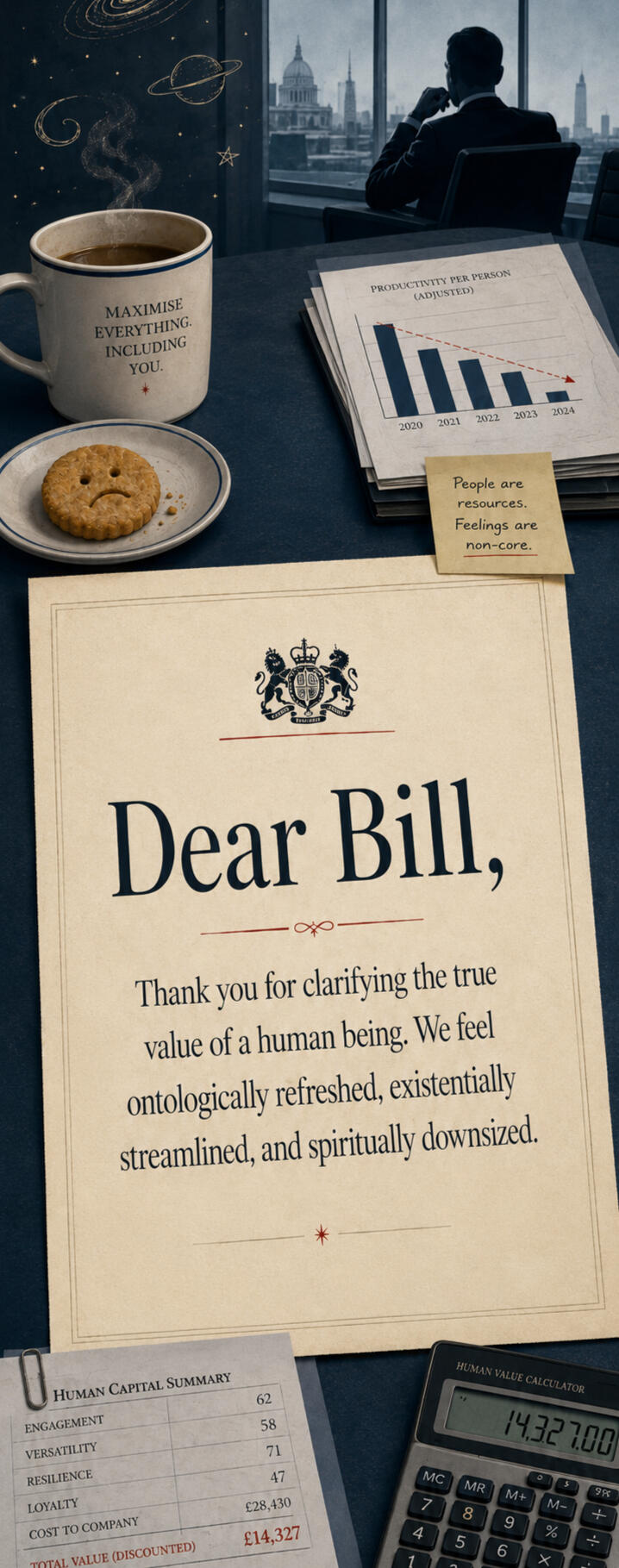
Dear Bill,
(and you other Bills and Billettes ... you know who you are)Thank you. Seriously.For centuries, philosophers, poets, artists, teachers, parents, children, dancers, stargazers, biscuit-dunkers and people who have cried at the end of Paddington 2 have struggled to define what a human being actually is.And then you came along and sorted it.Lower Value Human Capital.Lovely. Clean. Efficient.
No need for all that messy business about love, curiosity, friendship, courage, music, grief, joy, wonder, dancing badly at weddings, staring at the Moon, or remembering the exact smell of your grandmother’s kitchen.Frankly, Bill, we feel ontologically refreshed. Existentially streamlined. A tad spiritually downsized., but, you know, swings and roundabouts.At last, someone has had the courage to look humanity in the face and say: “Could this all be better represented as a cost metric?”
Songs dedicated to all the Bills out there
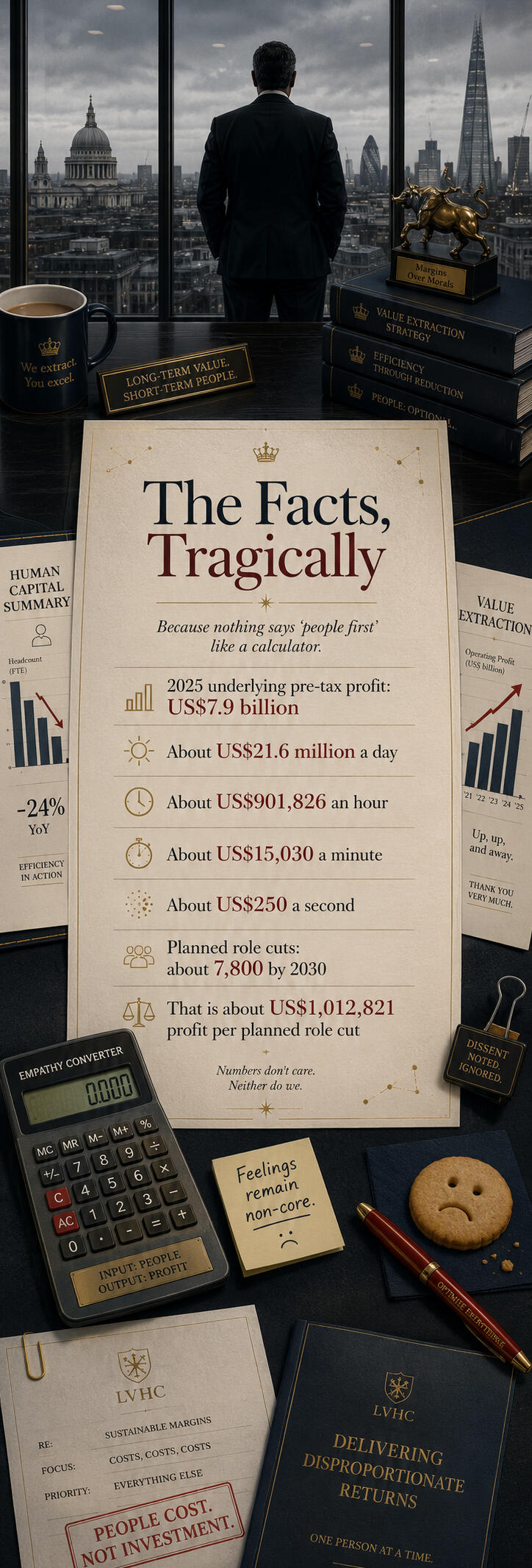
The facts (ish) ... tragically
In 2025, Standard Chartered made US$7.9 billion in underlying pre-tax profit,Standard Chartered announced plans to cut about 7,800 back-office roles by 2030 as part of a wider AI and automation strategy.If you divided those US$7.9 billion by the roughly 7,800 roles reportedly being cut, it comes to just over US$1 million per role. No way near enough to buy a Caribbean island.Bill Winters was reported as saying the plan involved replacing, in some cases, “lower-value human capital” with financial and investment capital.He later apologised for the upset caused by the phrase, while saying the remarks had been taken out of context.--------------------------------We accept this apology in the full spirit of modern corporate language, which is to say we have noted it, actioned it, aligned it with our values, and placed it in a folder called “FFS.”
Things lower value human capital has been known to do
Love people who are annoying.
Write songs.
Remember dogs’ birthdays.
Doodle in meetings.
Care for parents.
Teach children.
Touch each other.
Make tea.
Pub quizzes.
Look at the stars and cry.
Invent biscuits.
Forgive each other. Sometimes.
Refuse to be reduced to a spreadsheet, even quite a pretty one.
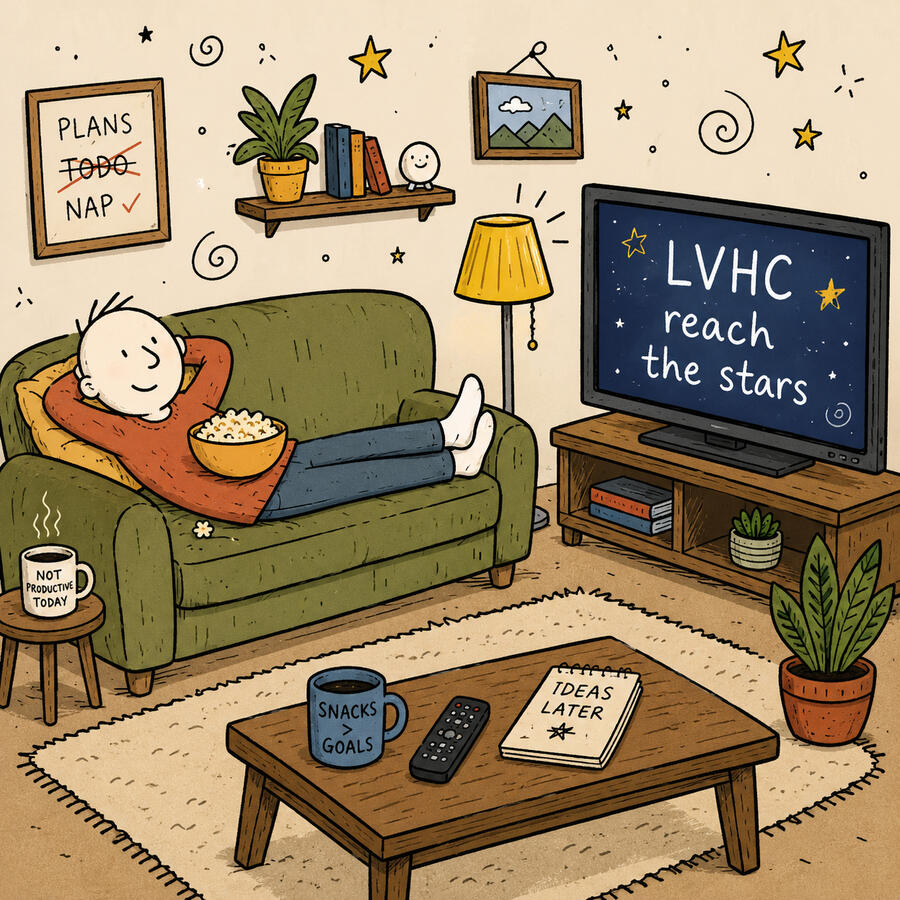
ho hum
This site is not trying to have a go. It's just LVHC was such a perfect phrase that says so much without meaning to, that... well. Nuff said.
And of course, this isn't a 'Bill' thing, it's a whole bigger thing that seems to be moving in.Cry. Laugh. Fiddle.
Whatever it takes.
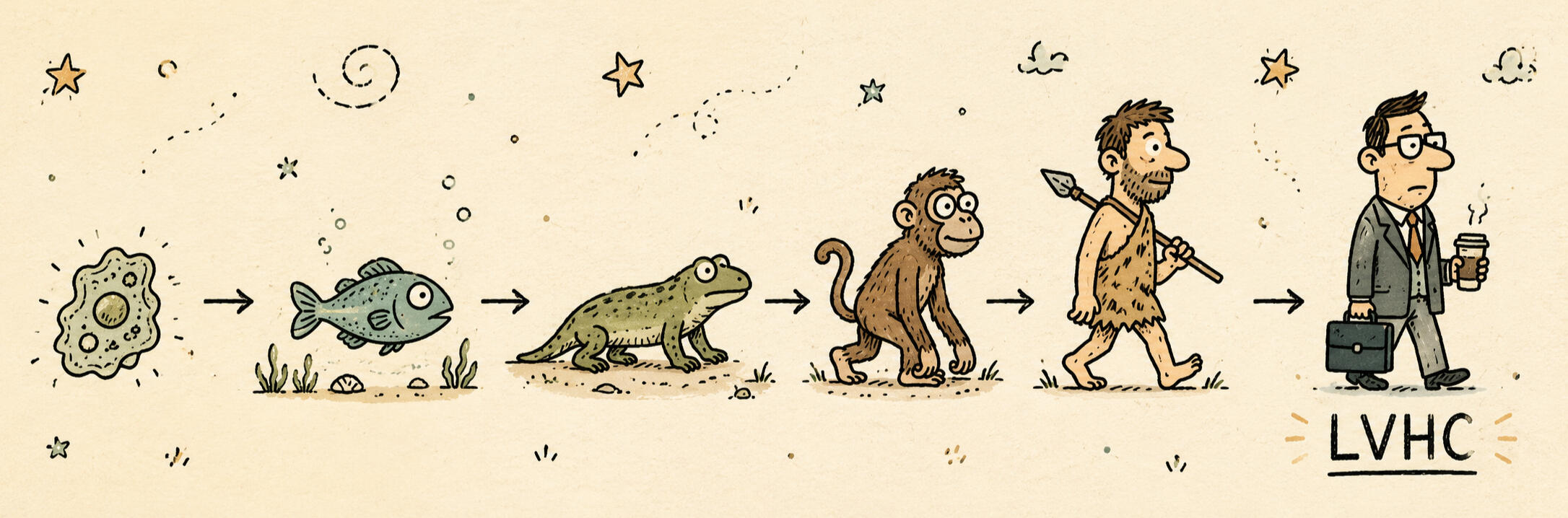
Say it loud...
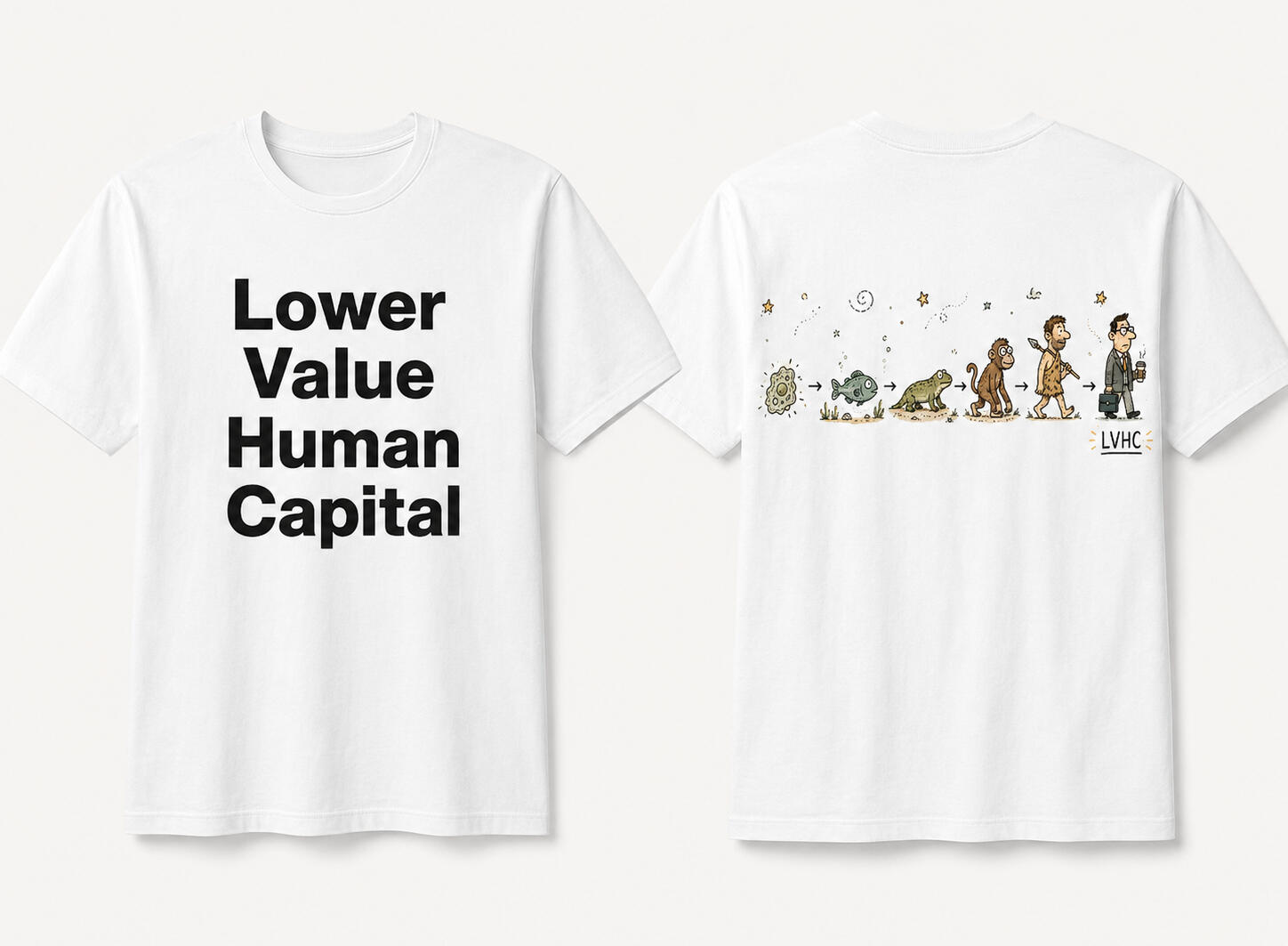
Couldn't resist designing one of these... gotta love AI, right?
Limited Edition coming soon if the robots tells us what to do.
The Story Behind Lower Value Human Capital
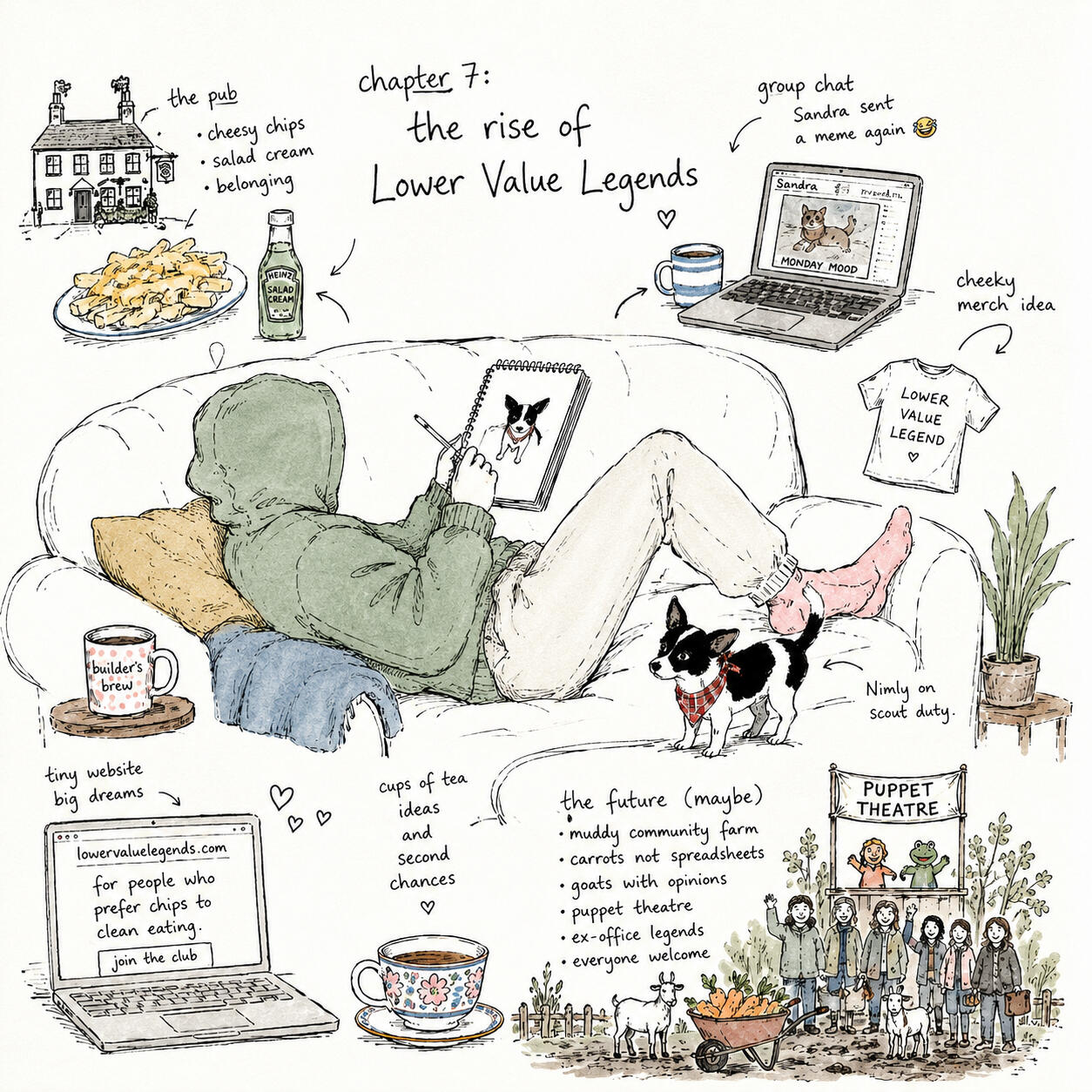
by Viral VeeI was doing an architecture degree at a goodish UK university back in 2023. Not top-top. Not “my parents have a wing named after them” top. But good enough that I had a ruler, some hope, and the vague feeling I might one day design public buildings full of light, plants, and people pretending not to eat lunch at their desks.Then 2024 happened, and I saw the digital wind blowing.AI started producing concept renders in seconds. Towers with trees. Libraries with floating staircases. Eco-villages for people who definitely owned linen trousers. I looked at my sketchbook, my student debt, and the little model I’d spent three nights building out of card, glue, and emotional instability, and thought: right. Lovely. That’s that, then.So I made what I thought was a sensible decision.I switched to finance.This was, in hindsight, a bit like running away from a bear by climbing into a lion enclosure. But at the time it felt clever. Finance had money in it. Architecture had dreams, unpaid internships, and very expensive pens. I thought banks would be safe because banks understand value. Banks understand risk. Banks understand service. Also, they have revolving doors, which make everyone look briefly important.I got the degree. I got the blazer. I got the pass card. I got a job at a good bank. I even started paying off my student loan, and by the time things began to go properly weird, I had cleared almost five per cent of it.Nearly five per cent.I know. Try not to be intimidated.For a while, I thought I’d done it. I’d made the grown-up move. I had a spreadsheet called “Be Brave”, a mug that said something awful like Empowered, and a drawer for emergency biscuits. When people talked about AI taking writers’ jobs, painters’ jobs, designers’ jobs, I felt terrible for them. Truly. From a safe distance. With a pension contribution.Then came the meeting.You know the kind of meeting. The title says something like Future Ways of Working, which is corporate for “bring your own emotional support mammal.” There were slides. There were biscuits. There was a man using the word “journey” with both hands. Then we were told we were being thanked, valued, realigned, restructured, and professionally removed from the building.Somewhere in all that came the phrase that did the damage.Lower value human capital.It was horrible, obviously. But also weirdly useful. Like being insulted by a spreadsheet and accidentally given a band name.That night, I met Lou in the pub. Lou is the sort of friend who knows grief requires carbohydrates before philosophy. She ordered cheesy chips with salad cream, because apparently some people choose violence through condiments. We talked about work, rent, AI, pride, panic, and whether I was “free now” or just unemployed with better branding.On the way home I was a bit drunk, a bit furious, a bit heartbroken, and briefly convinced I could do anything. Open a candle shop. Move to Scotland. Learn guitar. Become one of those women who owns good boots and knows the names of trees.Then I got home, failed to make toast properly, opened my laptop for one sensible career-related task, and somehow ended up scrolling rescue dogs.That’s where Nimly appeared.A tiny black-and-white dog with the face of a creature who had seen capitalism and found it poorly organised. He needed a home. He worried when left alone. I said, “Same, mate,” and applied before the sensible part of my brain could put shoes on.Nimly changed the tone of things. Not dramatically. He didn’t fix my life. He did not bring me a job offer in his mouth like a little HR spaniel. But he made the room less empty. He made mornings start with something other than dread and instant coffee. He also judged me very effectively, which was helpful during interviews.There were interviews. There were job applications. There was LinkedIn, which is a place where everyone is thrilled to announce something and nobody appears to own pyjamas. I wrote that I was “open to opportunities”, which was true, if by opportunities we mean paid work, emotional stability, and maybe a chair.I tried to explain my transferable skills. This was tricky because the forms wanted things like “commercial awareness” and “strategic leadership”, while my real skills were more along the lines of: calming Sandra down before she sends an email, finding the correct file called FINALFINALACTUAL_FINAL, making tea at exactly the right emotional temperature, and fixing a printer by whispering its name.Then I tried retraining. AI, obviously. Everyone said that was the future. So I signed up for a course called something like FutureProof Your You, which should have been illegal on grammatical grounds. I learned about prompts, tools, automation, branding, and the fact that I could ask a chatbot to make me employable and it would do so with horrifying confidence.Nimly sneezed on the certificate. Fair review.Then Sandra sent a meme.That’s when the whole thing shifted. The old work chat had been limping along with job links, crying faces, and Kev being weirdly upbeat. Sandra sent one stupid meme about being assessed by a cat in a necktie, and suddenly everyone woke up. We laughed. Then we got angry. Then we made more jokes. Then somebody said, “Should we actually do something?”That was how Lower Value Legends started. Not as a movement. Not as a plan. More as a group chat with snacks and unresolved feelings.But it grew.People joined. Ex-office workers. Admin ghosts. Call-centre survivors. Teachers. Drivers. Designers. Writers. Artists. People who’d been automated, restructured, optimised, outsourced, thanked, and removed. Eventually even AI coders turned up, which I did not laugh at. Out loud. Much.We pooled money. Sold shirts. Put songs online. Crowdfunded. Found land nobody glamorous wanted. Bought and leased bits of community farm space. Started workshops. Grew food. Ran repair days. Made puppets. Put on little plays. Built a theatre out of pallets and stubbornness. Sandra made a banker puppet with detachable empathy. Lou ran the chip van and insisted salad cream was now a heritage sauce. Dave made spreadsheets for goats. Kev became treasurer, which was alarming but somehow worked.It was not perfect. It was muddy, chaotic, and occasionally smelled of compost and wet fleece. Nobody magically healed because we planted carrots. Some people had a brutal year. Some people lost more than a job. The anger didn’t vanish, and I don’t think it should.Because we were lied to.We were told AI would help us. Then it was used to clear us out. We were told people were valued. Then we were valued at less. We were told change was natural, like weather, when really it had budgets, signatures, consultants, and very expensive language.But somehow, together, we made something from it.Not because losing our jobs was secretly wonderful. It wasn’t.Because we were still here.Because the so-called lower value people knew how to care, cook, fix, organise, laugh, sing, teach, mend, grow, and keep each other going when the official systems had finished thanking us for our service.This album tells my story with lots of tea and a little black-and-white dog.Oh, and by the way. I made all that up. But it's a good story right? Truth is, I am no way near as sorted with the whole LVHC thing. Right now, it 's just scary and it sucks. Raise a glass (or three) to hope.